
Transfer windows are commonly evaluated through the lens of player acquisition. The dominant narratives focus on individual signings, transfer fees, market opportunities, and negotiation outcomes. While these elements are visible, they represent the final stage of a much deeper organizational process.
From an executive perspective, transfer windows function as one of the clearest stress tests of organizational quality in professional football.
Unlike strategy documents, organizational charts, or public statements, transfer windows force clubs to make a sequence of high-stakes decisions under conditions of uncertainty, time pressure, information asymmetry, and public scrutiny. They expose the quality of leadership alignment, decision-making architecture, planning processes, and cross-functional coordination.
For this reason, transfer windows often reveal more about a football organization than the players eventually signed.
Transfer Activity as an Organizational Output
Many clubs continue to view transfer activity as a recruitment function. The evidence suggests a broader interpretation.
Recruitment departments identify and evaluate players, but the transfer window itself is the output of a wider organizational system. It reflects ownership ambition, sporting strategy, squad planning, financial control, coaching alignment, legal execution, and negotiation discipline.
According to FIFA, international transfer activity reached record levels in 2024. Men’s professional football recorded 22,779 international transfers and USD 8.59 billion in transfer spending. Across all categories, FIFA registered 78,742 international transfers, the highest figure ever recorded.
Exhibit 1 — The Transfer Market as a High-Pressure Operating Environment
| Indicator | 2024 Figure | Interpretation |
|---|---|---|
| Men’s international transfers | 22,779 | Record volume of player movement |
| Men’s transfer spending | USD 8.59bn | Second-highest annual spending level |
| Total international transfers | 78,742 | Highest level recorded |
| Women’s international transfers | 2,284 | Rapid market growth |
| Women’s transfer spending | USD 15.6m | More than double the previous year |
The transfer market therefore provides a high-density operating environment characterized by compressed timelines, multiple stakeholders, and limited tolerance for strategic ambiguity.
Why Transfer Windows Expose Structural Weaknesses
Most organizational weaknesses remain hidden during routine operations. Transfer windows create conditions under which these weaknesses become visible.
Three characteristics explain why.
Compressed Decision Cycles
Transfer windows require clubs to move rapidly from identification to evaluation, approval, negotiation, and registration.
This process demands alignment between:
- Ownership
- Sporting Director
- Head Coach
- Recruitment Department
- Analytics
- Finance
- Legal
Where governance structures are unclear, decision cycles lengthen and opportunities disappear. The resulting recruitment failures are often interpreted as market failures when they are, in reality, governance failures.
Cross-Functional Dependence
Few processes in football require greater coordination than player recruitment.
Successful acquisitions depend simultaneously on:
- Sporting fit
- Tactical fit
- Financial feasibility
- Contractual structure
- Long-term squad planning
Transfer windows therefore reveal the organization’s ability to coordinate expertise across functions.
Strategic Consistency Under Pressure
Periods of pressure tend to amplify existing organizational characteristics.
When deadlines approach and expectations rise, clubs face a fundamental choice between maintaining their recruitment philosophy and reacting opportunistically to market events.
The ability to preserve strategic consistency under these conditions represents a strong indicator of organizational maturity.
Stability and Performance
Research from the CIES Football Observatory consistently highlights the relationship between squad stability and sustained competitive success.
Their analysis of European football demonstrated that championship-winning teams maintained relatively low proportions of newly recruited players. Excessive turnover frequently reflects deficiencies in planning and continuity rather than ambition.
Exhibit 2 — Squad Stability and Performance Logic
| Squad Profile | Organizational Meaning | Likely Performance Implication |
|---|---|---|
| Low turnover | Continuity and planning | Greater stability |
| Moderate renewal | Controlled evolution | Healthy adaptation |
| High turnover | Corrective recruitment | Integration risk |
| Repeated high turnover | Structural instability | Reduced continuity |
Renewal is necessary. The organizational question concerns the reason behind transfer activity. Planned renewal reflects strategic control. Repeated corrective activity often indicates deeper weaknesses.
Spending Power and Organizational Capability
Transfer expenditure is a weak standalone indicator of transfer quality.
According to CIES, Chelsea invested approximately €2.78 billion in transfer fees over the last decade, while Manchester United recorded one of the largest negative net transfer balances in world football.
Meanwhile, clubs such as Benfica, Ajax, and RB Salzburg generated substantial positive balances through systematic talent identification and player trading strategies.
Exhibit 3 — Spending, Net Position, and Organizational Model
| Club / Category | Transfer Indicator | Strategic Interpretation |
|---|---|---|
| Chelsea | €2.78bn invested over 10 years | Extreme purchasing intensity |
| Manchester United | -€1.396bn net balance | High-cost squad construction |
| Benfica | +€816m net balance | Player development and trading capability |
| Ajax | +€473m net balance | Talent production model |
| RB Salzburg | +€401m net balance | Development-led recruitment |
| Club Brugge | Sustained positive trading model | Integrated recruitment and value creation |
Club Brugge represents a particularly instructive example. Over the last decade, the Belgian club has developed one of Europe’s most sustainable player trading models, combining recruitment discipline, squad planning, and long-term value creation.
Rather than relying on transfer activity to correct previous mistakes, the organization has built a repeatable system capable of producing both sporting and financial performance.
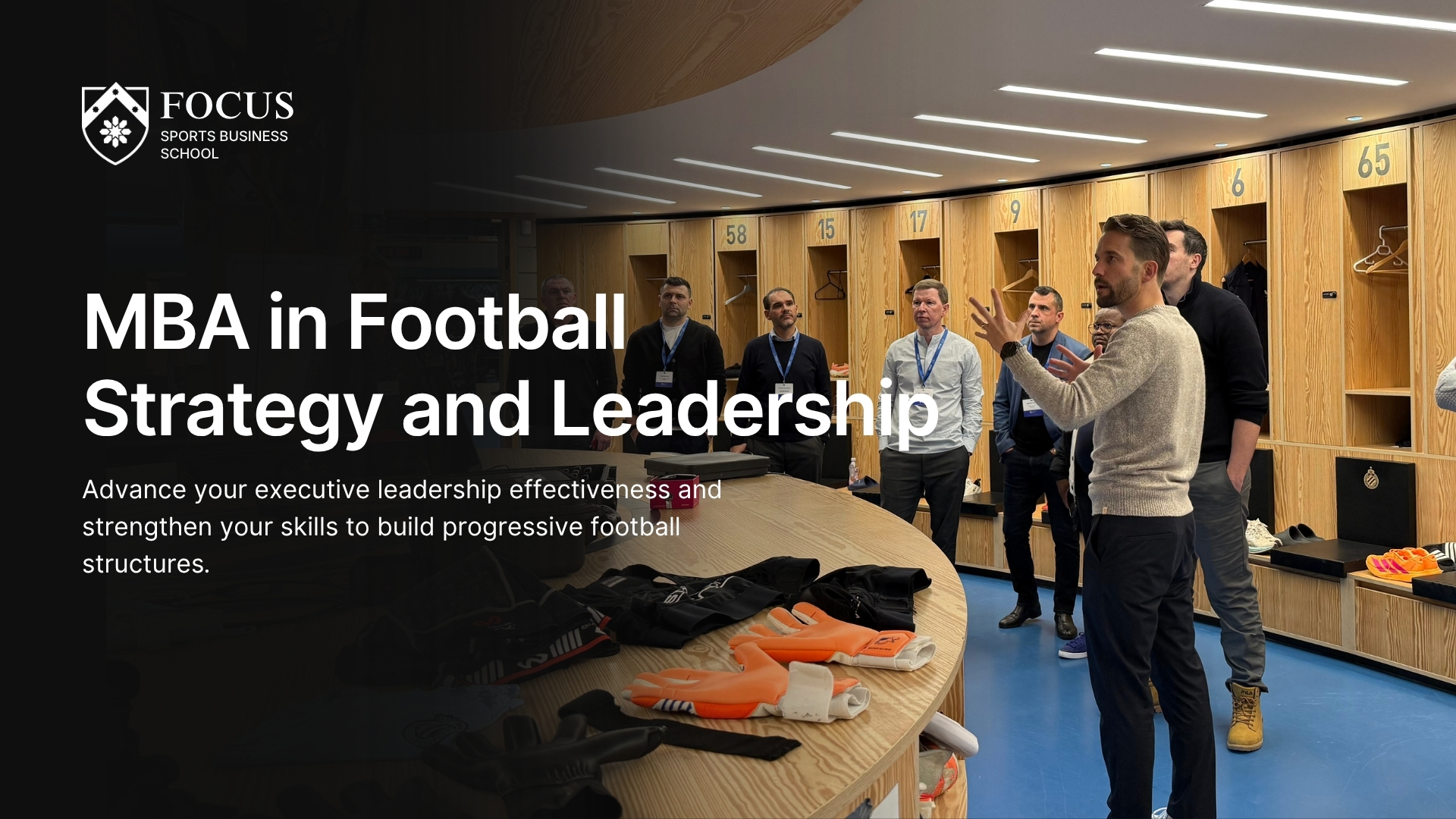
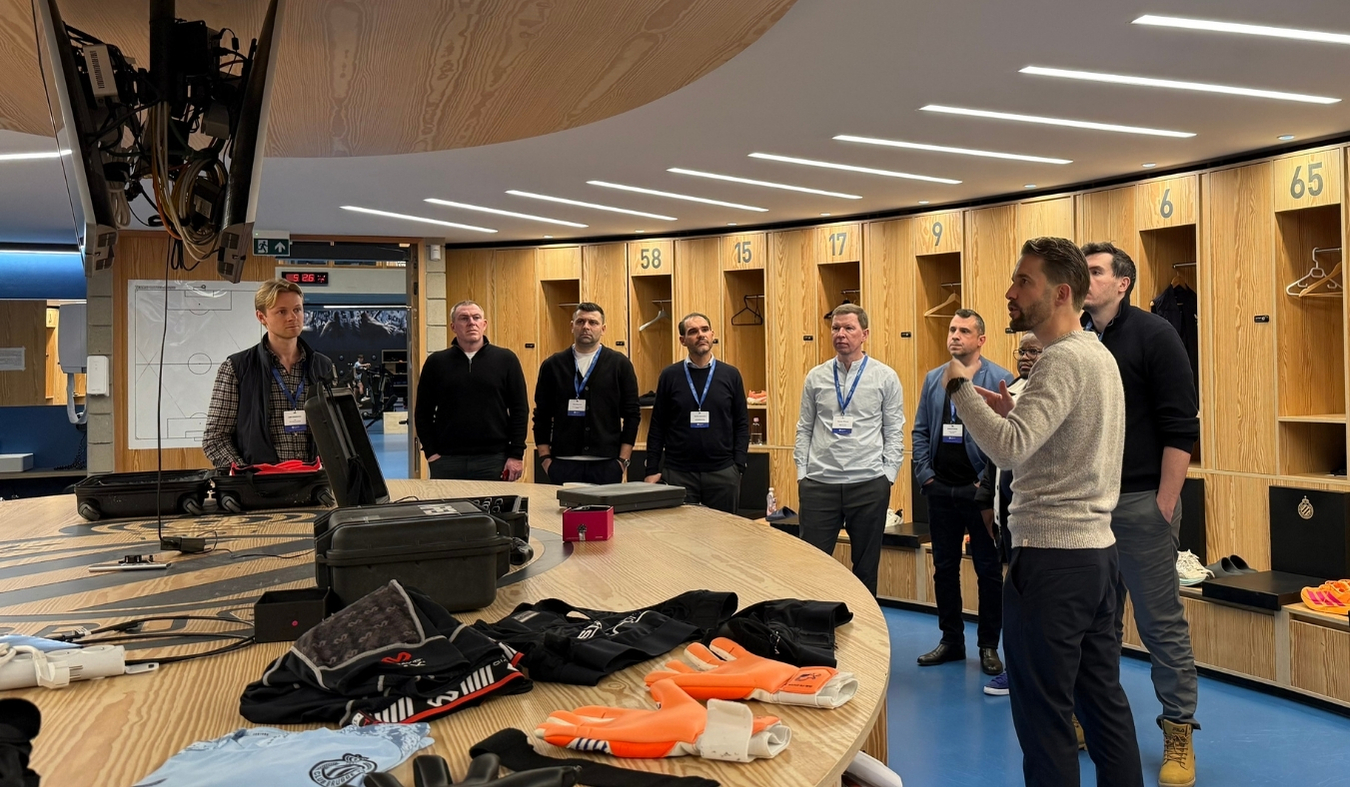
This approach is explored in depth by Devy Rigaux, ex Football Director of Club Brugge and module lead of Recruitment & Squad Building within MBA in Football Strategy and Leadership and Executive Diploma in Sporting Directorship programs. Drawing on his experience at Club Brugge, the module examines how leading clubs design recruitment structures, establish decision rights, and maintain consistency in squad-building processes.
Transfer Windows as Organizational Audits
Transfer windows expose organizational quality because they combine four forms of pressure simultaneously:
- Compressed decision-making
- Cross-functional dependence
- Strategic consistency under pressure
- Public accountability
Exhibit 4 — The Transfer Window Operating Model
| Capability | Weak-Club Symptom | Strong-Club Behavior |
|---|---|---|
| Ownership alignment | Late changes in priorities | Clear mandate before the window |
| Recruitment strategy | Shifting player profiles | Stable criteria linked to game model |
| Decision rights | Repeated delays | Clear recommend-approve-decide structure |
| Squad planning | Reactive gaps | Position-specific succession plans |
| Financial discipline | Opportunistic spending | Defined valuation limits |
| Execution | Slow negotiation cycles | Prepared target lists |
| Communication | Internal misalignment | Consistent stakeholder alignment |
Transfer windows should therefore be interpreted as organizational audits. They reveal the extent to which clubs are capable of converting information into coordinated action.
The Decision-Making Problem Behind Recruitment Failure
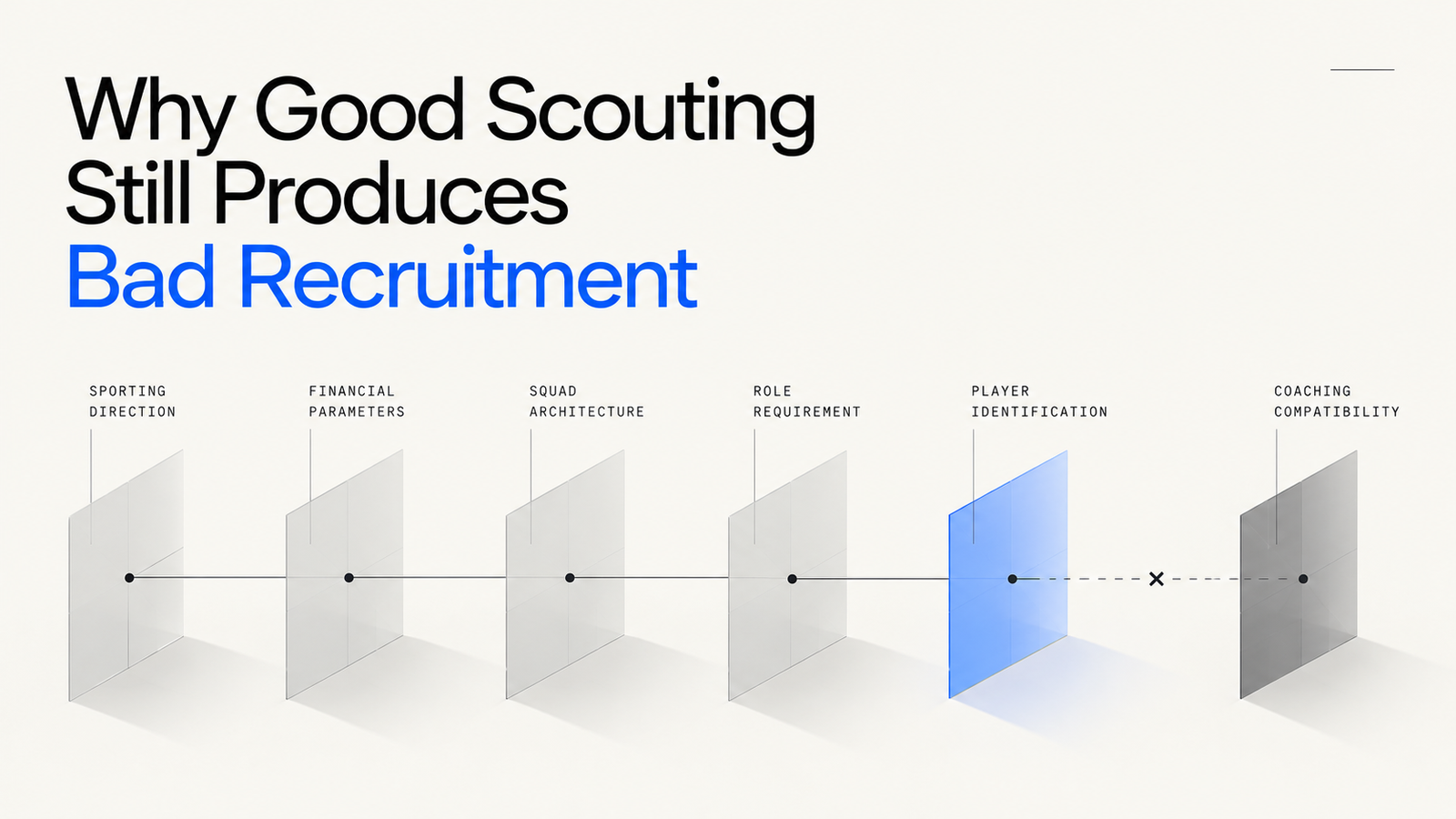
Many transfer failures are attributed to poor scouting. In practice, the more frequent source of failure sits upstream.
Clubs may possess strong player intelligence and still produce weak outcomes if:
- Ownership changes direction late.
- Coaching staff and recruitment departments operate with different criteria.
- Financial approval is disconnected from sporting priorities.
- Decision rights are unclear.
- Succession planning is absent.
The failure becomes visible through the player signed. The underlying causes are typically found in the decision architecture.
Exhibit 5 — Recruitment Failure Chain
| Stage | Failure Mode | Organizational Root Cause |
|---|---|---|
| Need definition | Wrong priorities | Weak squad planning |
| Profile design | Conflicting criteria | Lack of game-model clarity |
| Evaluation | Internal disagreement | Weak integration |
| Approval | Delays | Unclear authority |
| Negotiation | Overpayment | Weak valuation discipline |
| Integration | Slow adaptation | Insufficient cross-functional coordination |
The most advanced clubs treat recruitment as an integrated organizational process rather than a departmental activity.
A More Useful Question
At the end of most transfer windows, the industry asks:
Did the club sign the right players?
A more revealing question concerns the quality of the organization behind those decisions.
Transfer windows rarely fail because of player availability. They fail when organizations struggle to align information, authority, priorities, and execution.
The market merely exposes the quality of the system behind it.
Implications for Football Leadership
For Sporting Directors, Technical Directors, and club executives, transfer windows should be viewed as organizational examinations.
They provide an opportunity to evaluate:
- Leadership alignment
- Decision-making quality
- Recruitment effectiveness
- Cross-functional coordination
- Strategic consistency
Viewed through this lens, transfer activity becomes more than a market exercise.
It becomes a measure of organizational health.
The strongest transfer windows are usually produced by clubs whose structures, processes, and leadership dynamics were functioning effectively long before the market opened.
This article reflects the type of applied frameworks and executive-level discussions explored within the MBA in Football Strategy and Leadership and Executive Diploma in Sporting Directorship at FOCUS Sports Business School.