Football clubs have become increasingly sophisticated organisations.
Recruitment departments have specialised. Data and performance functions have expanded. Executive teams increasingly include expertise from finance, law, technology, commercial strategy and organisational development. Decisions that were once concentrated among a small number of individuals are now distributed across specialised functions.
Much of this represents necessary professionalisation.
But there is a risk in assuming that becoming more professional means becoming more like a conventional corporation.
A football club operates under a different set of conditions. Its primary competitive outcome is unusually uncertain. Sporting performance can change quickly. Coaches and players have comparatively short organisational lifecycles. Public scrutiny is continuous. And some of the organisation’s most valuable assets — identity, history, supporter relationships and local significance — cannot easily be recreated through capital or management intervention.
The management challenge is therefore more specific than professionalisation itself.
How should a club introduce greater organisational discipline without weakening the characteristics that make the institution coherent in the first place?
Vincent Mannaert addressed this problem through four interconnected elements of professional football strategy: culture, people and structure, dynamic stability, and the fan ecosystem.
The framework emerged from his teaching on football strategy execution within the MBA in Football Strategy and Leadership. It is useful not because the four elements constitute a universal formula for sporting success, but because each addresses a different organisational problem that professional football clubs need to manage.
01. Culture defines the boundaries of strategy
Culture is often discussed as an aspiration: the values an organisation would like employees to demonstrate or the behaviours leaders hope to encourage. Its strategic function can be more concrete. Culture can help define what an organisation will and will not do.
For a football club, this matters because strategic choices rarely exist in isolation. Decisions about coaches, player profiles, academy development, recruitment, commercial activity and organisational behaviour gradually establish an institutional pattern.

Without sufficiently clear boundaries, individually reasonable decisions can move the club in different directions.
This makes culture less a communications exercise than a decision constraint.
A strong culture does not prescribe every decision. It establishes enough continuity that different people can make decisions without repeatedly renegotiating the organisation’s fundamental assumptions.
That distinction is important in football, where personnel turnover is structural. Executives leave. Coaches change. Players move. Ownership can change. A club whose principles exist primarily in particular individuals risks losing strategic continuity whenever those individuals depart.
The relevant leadership question is therefore not simply whether the club has articulated its values.
It is whether those principles are sufficiently embedded to influence real choices when another option appears financially attractive, competitively expedient or politically easier.
Culture becomes strategically meaningful at the point where it changes a decision.
02. Expertise creates value only when the organisation can coordinate it
Professionalisation naturally leads to specialisation. Modern football organisations may contain expertise across recruitment, data, medicine, sports science, academy development, psychology, finance, legal affairs and performance, alongside coaching and executive leadership.
Adding expertise increases the organisation’s potential capability. It does not automatically increase its actual capability. As specialisation increases, so does the need for coordination.
A recruitment department may evaluate a player differently from the coaching staff. Finance may understand the risk of a transaction differently from the sporting department. Performance specialists may identify requirements that conflict with short-term competitive priorities.
None of these perspectives is necessarily wrong. The organisational problem is how they are combined. This is why the second component of the blueprint connects people with structure.

Structure determines where expertise sits, who is responsible for what, how information moves between functions and where decisions ultimately belong. Clear protocols reduce the likelihood that collaboration depends entirely on personal relationships or informal authority.
The distinction is subtle but important:
Hiring better people improves individual capability. Designing how those people work together improves organisational capability.
The objective is not to eliminate disagreement. In specialised organisations, disagreement can be valuable because different functions see different dimensions of the same decision.
The objective is to make disagreement usable.
A professional structure therefore needs clarity around responsibilities, information flows and decision rights: who contributes, who challenges, who recommends and who ultimately decides.
Without that architecture, additional expertise can increase organisational complexity faster than it increases decision quality.
03. Stability should preserve direction
Football creates strong incentives for reaction. A sequence of poor results can increase pressure to change the coach, recruitment priorities, playing approach or organisational structure. Conversely, periods of success can encourage organisations to preserve systems long after the environment around them has changed.
Neither constant change nor permanent continuity constitutes a strategy. Mannaert’s third principle is better understood as dynamic stability.

The concept contains an important tension. A club needs sufficient stability to accumulate knowledge, develop people and execute decisions over multiple seasons. But it must also remain receptive to new information and capabilities.
Data and artificial intelligence are examples. Their emergence does not necessarily require a club to abandon its existing football philosophy or organisational identity. They may instead improve how an established organisation observes, evaluates and executes.
This suggests that different parts of a football organisation should be allowed to change at different rates.
Institutional principles and identity can provide long-term continuity.
Organisational structures and capabilities should evolve when the club’s requirements change.
Methods and technologies may need to adapt considerably faster.
Competitive decisions will inevitably respond most frequently to immediate conditions.
The strategic error is treating all four as if they operate on the same time horizon.
A club that changes its underlying direction whenever operating conditions change becomes unstable. A club that protects every existing method in the name of consistency becomes rigid.
Dynamic stability requires leaders to distinguish between changing how the organisation works and changing what the organisation fundamentally is.
04. The fan relationship is not an ordinary customer relationship
Perhaps the most distinctive part of the framework concerns the supporter. In conventional management thinking, organisations frequently redesign products, brands, locations and customer experiences when management believes doing so will create greater value. Football complicates that logic.
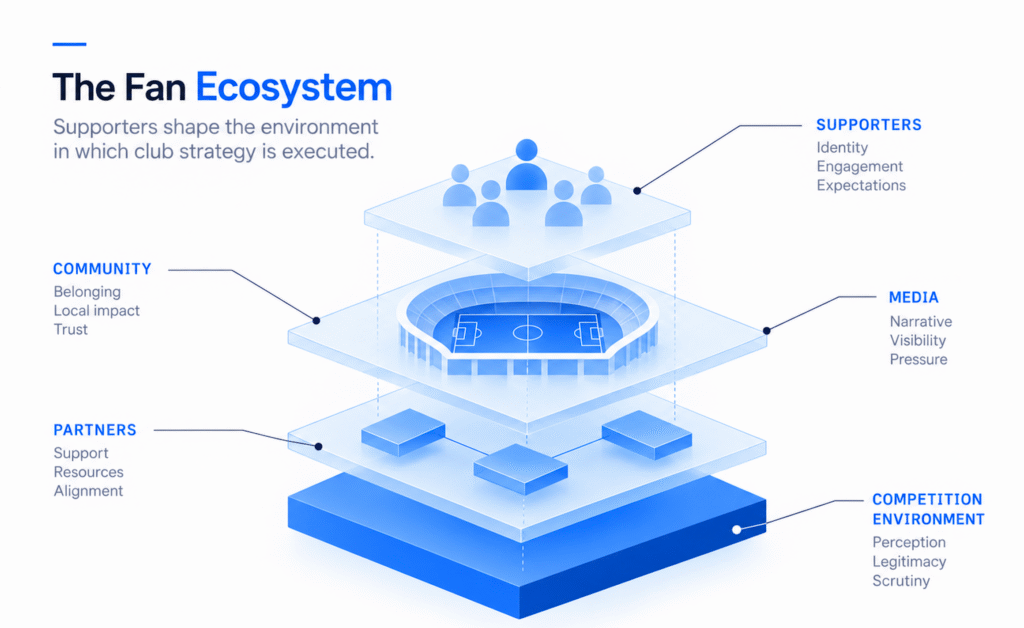
Supporters do not necessarily relate to clubs in the same way customers relate to products. Club colours, symbols, stadiums, geography and traditions can accumulate meaning over generations. Their value is partly economic, but also social and institutional.
This creates a different management responsibility. It does not mean that football clubs should resist commercial development or preserve every tradition indefinitely. It means that some decisions affect assets whose value is difficult to capture through conventional financial analysis alone.
A change can make commercial sense and still impose an institutional cost. This is why Mannaert’s fourth principle is better understood as respect for the fan ecosystem, rather than simply fan engagement. The distinction matters. Engagement asks how the organisation communicates with supporters.
An ecosystem perspective asks how the club exists within a network of relationships, identities and expectations that management did not create and does not fully own.
That changes the decision threshold. The more closely a decision touches the institutional identity of the club, the less appropriate it becomes to evaluate that decision through commercial or operational criteria alone.
The more closely a decision touches the institutional identity of the club, the less appropriate it becomes to evaluate that decision through commercial or operational criteria alone.
The four disciplines work as a system
The framework becomes more useful when the four components are considered together. None is sufficient independently. A strong culture without organisational structure may produce shared beliefs but inconsistent execution.
A sophisticated structure without cultural clarity may coordinate activity efficiently without establishing a coherent direction. Stability without adaptation can institutionalise outdated practices. Adaptation without stability can leave the organisation permanently rebuilding itself.
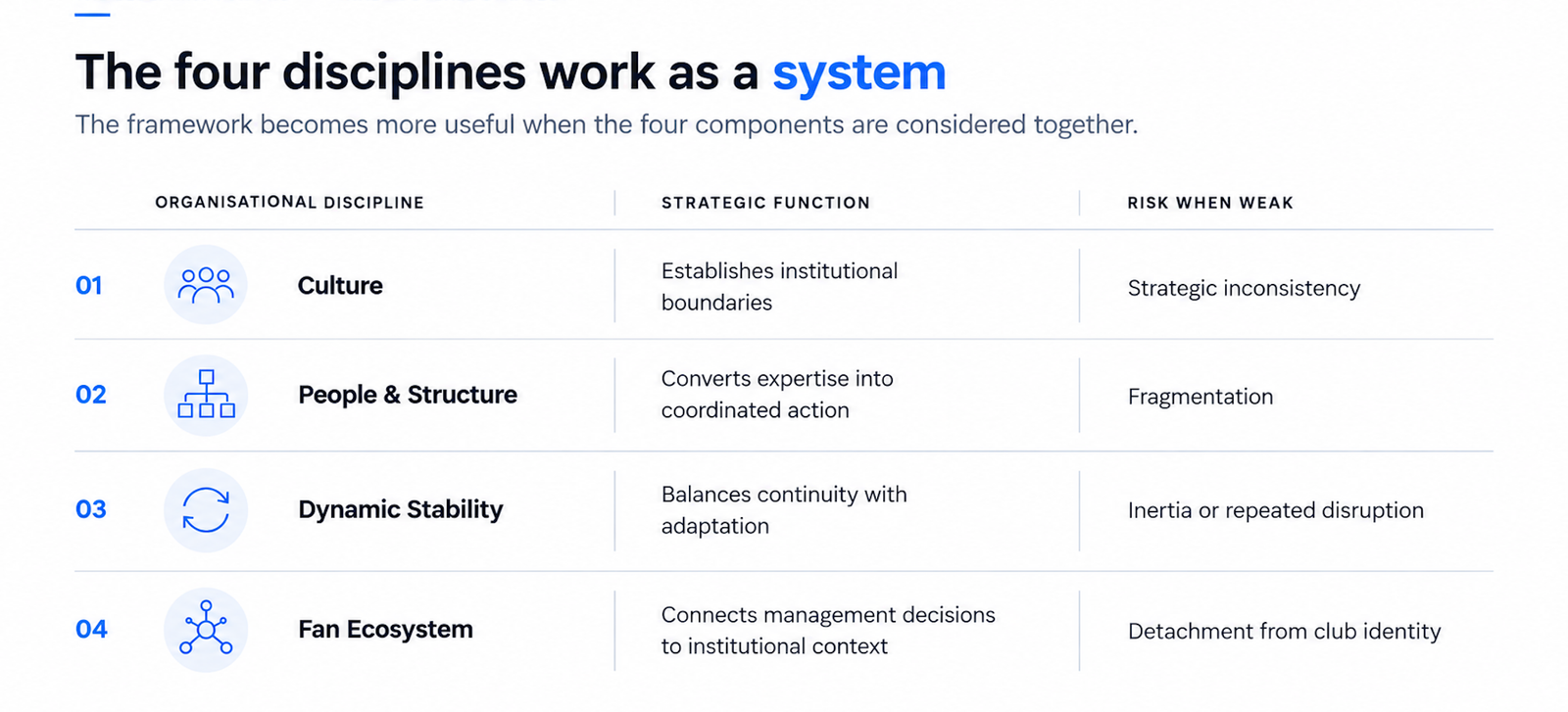
And commercial sophistication without an understanding of the supporter ecosystem can optimise measurable value while weakening forms of institutional value that are considerably harder to rebuild.
The central management task is therefore not to maximise any single pillar.
It is to maintain coherence between them.
Three implications for football leaders
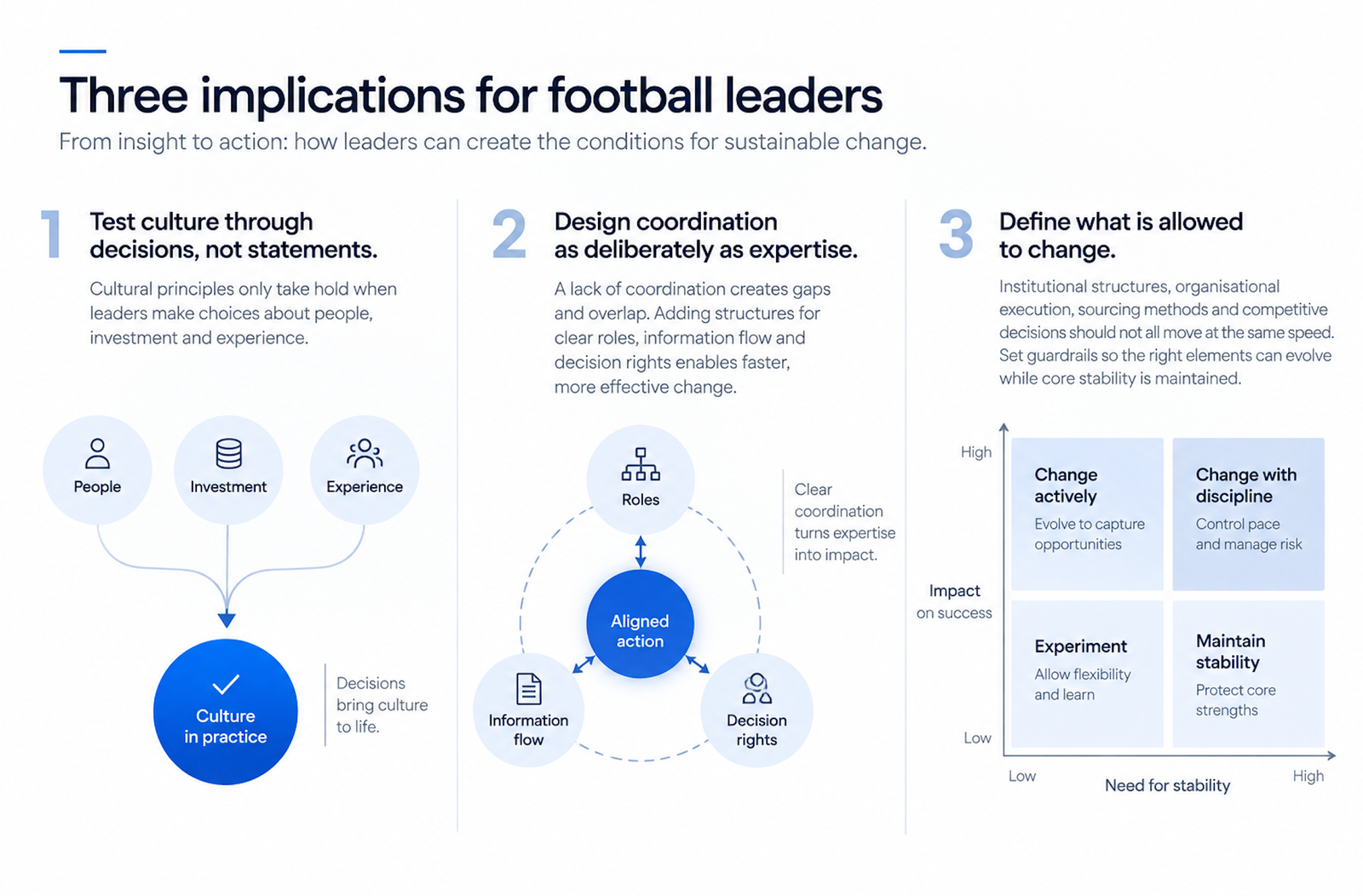
- Test culture through decisions, not statements. A cultural principle has strategic value only when it influences choices about people, investment or direction.
- Design coordination as deliberately as expertise. Adding specialists without clarifying responsibilities, information flows and decision rights can increase complexity without improving decisions.
- Define what is allowed to change. Institutional identity, organisational structures, operating methods and competitive decisions should not necessarily move at the same speed.
Executive Summary
Professionalising a football club requires more than adding expertise, technology and management processes. Vincent Mannaert’s framework identifies four organisational disciplines that need to develop together: culture establishes strategic boundaries; people and structure convert expertise into coordinated action; dynamic stability allows the organisation to adapt without repeatedly changing direction; and respect for the fan ecosystem recognises forms of institutional value that extend beyond conventional commercial logic.
The underlying challenge is coherence. As football organisations become more sophisticated, leaders must ensure that increasing specialisation and adaptability strengthen rather than fragment the institution.
Source & attribution note
This framework is based on practitioner material presented by Vincent Mannaert, drawing on his experience in football executive leadership, and developed during his teaching on football strategy within the MBA in Football Strategy and Leadership. FOCUS has structured and interpreted the material through an organisational-design lens; analytical extensions beyond the original framework are presented as analysis. The MBA itself focuses on leadership, organisational effectiveness, strategy execution and technical decision-making within football organisations.